Home

News

Marine Nematode Research

Parasitology Research

Student Research

Teaching

Publications

Education

Hamilton College Biology

Ashleigh B. Smythe
Visiting Assistant Professor
Hamilton College

198 College Hill Rd.
Clinton, NY 13323

Office: Science Center 2033
Office phone:  315-859-4997
Email: asmythe@hamilton.edu

Research Interests

My research focuses on the evolution and ecology of invertebrate animals.  While my primary research interest is in the evolution and diversity of free-living nematodes, students in my lab also conduct research on other invertebrates, especially parasites.
<em>Cyclicolaimus</em> sp. has a comb of teeth in its mouth and large sensilla (setae).
En face view of the bacterial feeding soil nematode <em>Acrobeloides uberrinus</em> (strain JB-27)
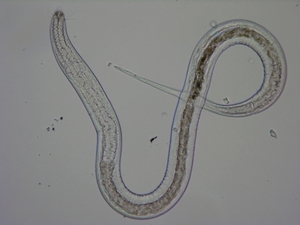
A juvenile of the marine nematode <em>Mesacanthoides</em> sp.
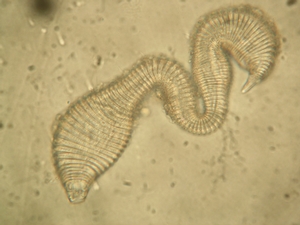
Members of the Epsilonematidae have a characteristic epsilon shape to their bodies.
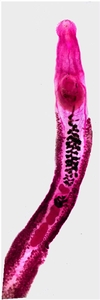
The trematode <em>Quinqueserialis quinqueserialis</em> from the intestine of the muskrat.
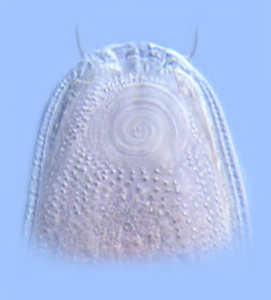
<em>Cheironchus</em> sp. has a large, spiral ampid, a chemosensory structures foud in all nematodes.
<em>Ceramonema</em> sp. are so named for the ceramic tile-like appearance of their cuticle.
The esophageal reagion of a species of <em>Cephalobus</em> sp., a bacterial-feeding soil nematode.
The head region of <em>Neotylocephalus</em> sp., sporting a circular amphid and flaps of cuticle.
The trematode <em>Echinostoma</em> sp. from the intestine of the muskrat.
prev next

Free-living marine nematodes

Marine sediments support by far the greatest diversity of nematode species, and I aim to understand their diversity, evoluton, and taxonomy.

Parasite ecology and evolution

My students and I study a variety of parasitic worms.  We have examined the diversity and distribution of leeches infecting turtles, the community of parasites in muskrats, and the effect of the mouse nematode Heligmosomoides bakeri on a model of type I diabetes.